Malaysia – A recent field visit in Malaysia as part of Output 4 of the ASEAN-JICA Food Value Chain Development Project (AJFVC) assessed key models by observing government programs that support the food value chain. This initiative highlighted an integrated Public–Private Partnership (PPP) ecosystem in which governmental bodies, academic institutions, producer organizations, and private companies play complementary roles throughout the Food Value Chain (FVC). Located in Ayer Baloi, Pontian, Johor, Grandpine Agropark serves as a primary case study of how collaborative models bridge the gap between public support and private commercialization to build resilient food value chains.
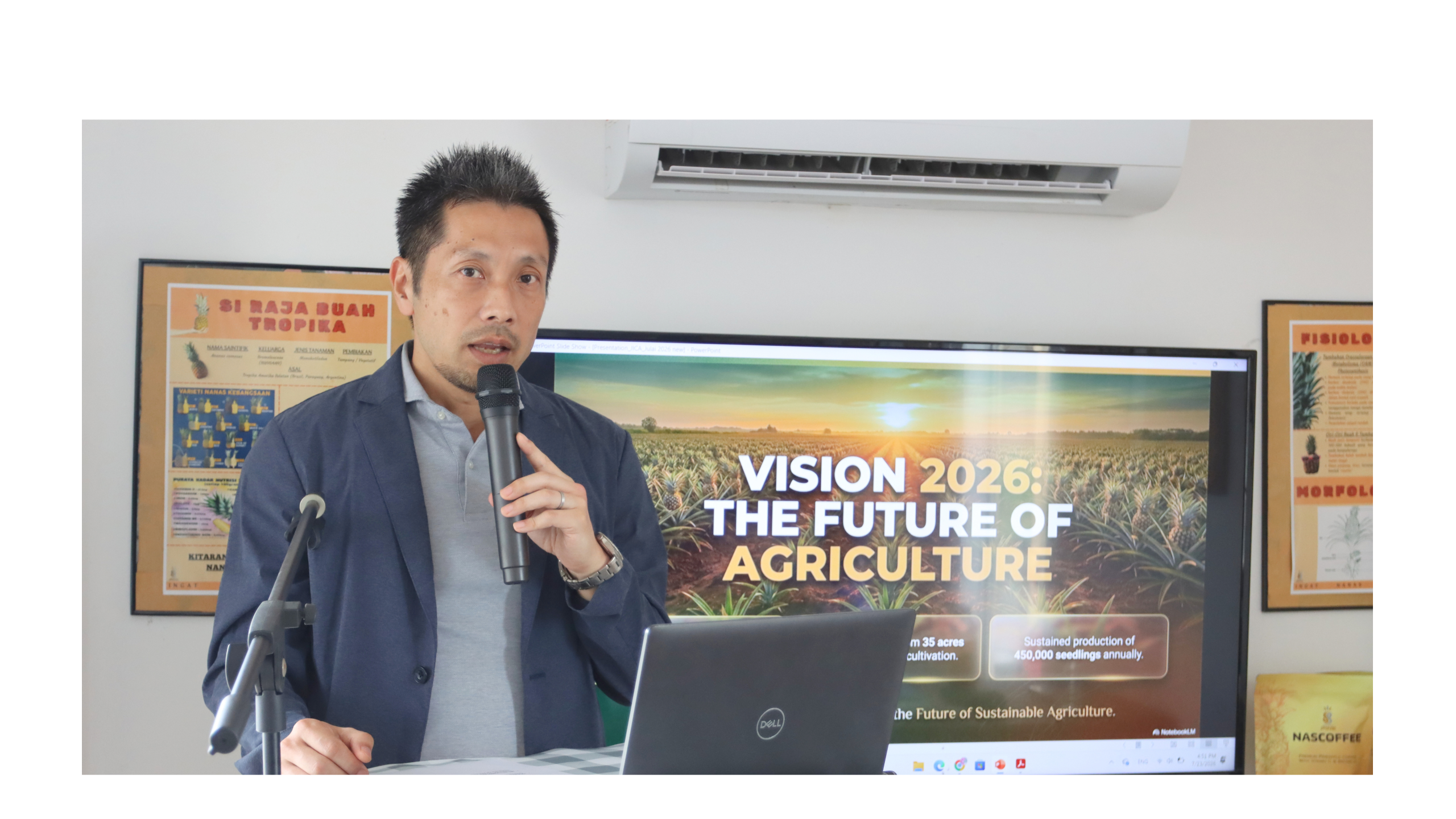
Grandpine Agropark, owned and managed by agricultural practitioners Mr. Iskandar and Ms. Istiqomah, operates 35 acres of framland dedicated premium MD2 pineapple, an internationally recognized variety originating from the Philippines. Rather than operating in isolation, Grandpine’s rapid development is powered by blended capital and multi-agency public coordination. Over its operational history, the enterprise strategically secured competitive government grants, including the Young Agropreneur Grant (RM 20,000 in 2018), B40 Entrepreneurship Grant (RM 10,000 in 2021), Rise Up Program (RM 100,000 in 2023), Agrotourism Grant (RM 200,000 in 2024), and a matching grant (RM 20,000 in 2025), resulting in a balanced capital structure where 36% of funds originated from public assistance and 64% from self-financed reinvestment without commercial bank debt. This financial de-risking allowed the enterprise to adopt agricultural drones for spraying, build a 450,000-seedling nursery, and achieve nearly 400% revenue growth over a three-year period.

                               Pesticide application by drones
 Source: AJFVC Documentation
Grandpine leverages specialized technical support from across Malaysia’s public agricultural apparatus to create an end-to-end value chain. While the Farmers’ Organization Authority (LPP Johor) and Area Farmers’ Organization (PPK Ayer Baloi) provide funding governance and institutional oversight, the Malaysian Pineapple Industry Board (LPNM) supplies agronomic guidance and trials for new disease-resistant cultivars like MS16. In parallel, the Malaysian Agricultural Research and Development Institute (MARDI) delivers technical formulations for downstream food processing, and the Department of Agriculture (DOA) assists with Good Agricultural Practices (MyGAP) certification. These institutional partnerships enable Grandpine to buffer against raw commodity price swings by producing shelf-stable, high-margin consumer products—such as pure pineapple juice, artisanal jams, pineapple coffee, and chocolate beverages—marketed through its on-site café, agrotourism tours, and commercial off-take partnerships with food manufacturers like SSM Enterprise.
Beyond downstream processing, Grandpine functions as an active private incubator under LPP Johor’s RM 200,000 Agriprentice Program, mentoring five participants from diverse backgrounds, including university graduates in veterinary medicine and transitioning professionals. With program funding directly covering critical assets—seedlings (RM 100,000), fertilizers (RM 40,000), planting media (RM 20,000), machinery (RM 20,000), and training (RM 20,000)—the initiative implements a phased three-year ramp-up. Mentees begin by managing one acre while retaining their primary employment, expand to three acres in the second year, and eventually graduate into independent, full-time commercial producers managing five acres with a targeted net monthly income of RM 8,000. This incubation structure establishes a mutually reinforcing commercial loop: aspiring agropreneurs achieve economic mobility, while Grandpine secures a consistent supply of quality raw pineapples to fulfill its processing demand, demonstrating a scalable blueprint for public–private agricultural transformation.
The Grandpine Agropark case demonstrates how coordinated public-sector interventions can accelerate food value chain development in Malaysia. A range of technical, institutional, financial, and capacity-building support provides the foundation for private-sector investment, value addition, and market expansion. This public–private partnership model contributes to a more integrated and sustainable food value chain by connecting public support with private-sector capacity and market opportunities.